War is stupid. That is, it is a bad way to solve human problems. It also makes you stupid, the closer you are to it, physically, emotionally. When you are near to a war you start saying things to yourself like "War is stupid" which is, itself, a stupid thing to think. Of course war is stupid! you say in response to yourself as you walk down the street muttering, shlepping seven bags of groceries from the SuperDealSolde as you carry on all sides of a stupid, inchoate argument about stupid, stupid war, in your head. Ariela says that she gets to the point of saying "Rrrrr" a lot these days.
The impossibility of writing something not-stupid about War (when written with a capital letter please imagine the word pronounced in all its stupid significance) has prevented me from writing at all since the outbreak of The War. I have felt too stupid to say anything useful about this War, what The War means, or War-In-General and of course it seems vulgar to write about other things when there is a War going on, so I have put all my effort into writing fiction. War is the context we give to the times when we go ahead and do what we know we shouldn't do -- try to kill other people. "Please don't kill me," you say, "I just bought all these groceries at Supersoldedeal. And besides it is wrong to kill somebody, everyone knows that." "Oh, but it's war..." "Oh, well okay then. Maybe you'll rape and pillage as well?" "Well, it is War, maybe I cheat on my taxes too, hee hee."
There are so many examples of how War en-stupid-itates people. Here is one example that got me. I read in an email that the tenor of the Anti-War rally in Montreal was really anti-semitic. I was curious so I went on Youtube to see video clips. I didn't see anything particularly anti-semitic but I did hear some pretty explicit anti-intelligence, to wit people chanting, "No Justice, No Peace." That floored me. I wondered who exactly these people thought they were representing, or supporting, or whatever. No Justice, No Peace?! Is that supposed to be a pro-Gaza chant?! Do these people want more war for Gaza?! More one ton bombs?! That'll teach those Zionist running dogs a thing or two about justice. Do these demonstrators want more cluster bombs and artillery shells dropped on the Gazans they are purportedly supporting?! Maybe they want more mortars and katushas shot at Israel? I don't think so, but even if they hate Israel and Israelis enough to want that, they can't like what it brings. At the very least they ought to come and launch the mortars themselves so the brave freedom-fighters of Gaza can have a smoke break between shelling Israeli civilian targets. "No Justice, No Peace" could be the marketing catch-phrase for War itself. Of course, you can't really blame the yahoos who were chanting this; It's War and War is when people's brains stop working. When stupidity reins.
"Open the gates of cluelessness, and unleash the dogs of dumb." That's Shakespeare, Stupid, in case you didn't know!
Friday, January 9, 2009

Wednesday, December 17, 2008
I miss mullets
 Continuing my hair theme: The other day I saw a really strong mullet. This was a young Arab guy. It was classic, a sort of jerry-curled billy-ray cyrus thing. The guy sporting it looked pretty tough and even if I had had a camera there was no way I was going to snap his picture. I have only seen two mullets here in Israel. The other one was a few months ago and on a Russian-looking guy. What's Russia- looking? Well it was old-style Russian, like the guys I knew twenty years ago when I was on kibbutz. He was wearing a lot of acid-washed denim for one thing. He was blond and pale and he had a whispy blond moustache which completes the mullet well.
Israel is a society of short hair and long hair. Israel likes dualisms, clear dichotomies. Arab/Jew Secular/Religious, Sabra/Immigrant short hair/long hair. Short hair says neat, organized, tough and military. Long hair says hippy, rebel, soft, hiding. Those are the choices and guys go with them. Arab guys, too, while sporting lots of styles are not really adventurous; they adhere to the two basic styles rule, long or short. Mullets blow up dichotomies like that. They are anti-hippie, small-town, conservative but rebellion. Business up front, party at the back. At least that's what I always see when I see a mullet (at least on a guy). Debbie's friend Matt Bissonnette's book Smash Your Head on the Punk Rock has a classic mullet scene when some anglo kids go on an exchange trip up in Point-au-pique and meet a French Canadian guy who is like the coolest thing in his small town and the narrator calls him "the lord, high King Pepper". It is a pretty funny scene in a funny book. The narrator ends up getting worked over by the lord, high King Pepper for messing with his girlfriend.
It is noteworthy that both the mullets I have seen were solitary. I think of the mullet as needing at least one mullet-follower, somebody sporting a less committed mullet, a mullet fellow-traveller. It must be lonely wearing a mullet here.
The guy I saw this week had seriously luxurious looking curls in back, and some wet-look product on. In addition to making me think of Absalom, who I had on the brain anyway, it reminded me of a theme in the Illiad -- the ultimate West versus East book --- about the Trojans and their curled and scented hair, how the Greeks disdain them for it. But, of course, Paris woos away Helen with that hair. I'll have to ask David -- a classicist -- about it when I see him this weekend if he remembers what I'm talking about. My guess is the Trojans had the pretty-boy long hair, the Greeks had the short hair. Not a lot of room for in-between or stylistic equivocation when you are on the battlefront of the clash of civilizations.
Saturday, December 13, 2008
Absalom, Absalom Hairstylists
I got my hair cut by a guy named Eitan Avshalom (the Hebrew of Absalom). I commented on the irony of someone named Avshalom cutting hair. He said, “Why? Because he and his father fought?” It is one of my favourite stories from the bible and one of the saddest. This Avshalom didn't know the end of it. I'm doing this from memory so excuse me if I get the details wrong (as I pointed out in a previous post my memory is such that I could be making this whole thing up so better go check your bibles). King David loves Avshalom who is very handsome and has beautiful long hair. Avshalom ends up rebelling against the rule of his father (he has good reasons; David is ignoring a lot of awful stuff going on in his family). Things are touch and go for David for a while but eventually Avshalom and his forces are on the run, about to be defeated. There is a final battle and David tells his men, don't kill my son because I still love him. But Yoav– the King's trusted military man -- finds Avshalom. Avshalom's chariot ran under a thorn tree and his beautiful long hair has tangled in the tree, lifting him out of his chariot leaving him suspended in the air and helpless. Yoav doesn't hesitate. He stabs Avshalom “under the fifth rib” (Yoav is David's heavy, a wetwork specialist, and he does a couple of people “under the fifth rib,” as I recall). David finds out and cries, “But I told you to leave him alive.” Yoav tells him, in effect, you aren't just a dad fighting with a son, you are king and when someone rebels against the king, even the king can't forgive that. Raison d'etat. The haircut – to give Eitan Avshalom his due -- is pretty good.
What do you do when you need an Yoav for your Yoav?
In related news, the Israeli Labour Party, in a panic at polls predicting that they are going to be reduced to a sliver of their former power, have decided to go negative with their election advertising. In Israel this isn't big news. Kadima has giant ads saying “Bibi (Benjamin Netanyahu, leader of Likud and the acknowledged front runner) I don't trust him.”
The amazing thing about Labour's campaign is that they've gone negative against THEMSELVES. The ad on the bus I saw yesterday had a big picture of Labour Party leader Ehud Barak and the text said “Lo simpati. Manhig” which might roughly be translated as “Not likeable. A Leader.” Obviously some bright light decided that Labour couldn't hide its considerable liabilities – principally the fact that Israelis don't like Barak – so they might as well put them front and centre. There's going to be a whole series of ads saying thing like "He's not nice. A leader." "He's got cooties. He's a leader. "
It seems that there is nobody left in the back rooms of these parties who can say goodbye to these guys. In Canada, if you loose an election your party's backroom boys tell you thanks very much and go away now. Everyone was appalled that Stephane Dion didn't know this, until eventually someone pricked him gently under his fifth rib and indicated the door.
In Israel, the backroom guys, the ones who in Canada would be considered too soaked in blood for party leadership aren't in the backrooms (That's both figurative and literal blood, Barak and Netanyahu were in the Israeli equivalent of the green berets and Barak, at least, spent a fair amount of his military career parachuting into Lebanon and other resort locations at night and killing enemies, eventually becoming Israel's most decorated soldier). 
What do you do when you need an Yoav for your Yoav?
Wednesday, December 3, 2008
Playing hookie at the deepest hypersaline lake in the world
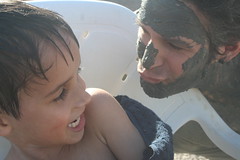 Took the kids out of school and went to the Dead Sea today. Here's what I learned from wikipedia about the Dead Sea. There are no macroscopic organisms living there; It's dead. And its a lake. Hence the name.
We went to the national park at Einot Tsukim. I saw two beautiful birds there, neither I can identify with confidence but one was a little green guy travelling with a buddy who was shy to let me get near. I think it was a little green bee eater (none other than the shrakrak gamadi) and a white-throated kingfisher (again I wouldn't put money on it). I'm pretty sure it was some kind of kingfisher but it was big, bigger than the 25 cm my guidebook gives the Shaldag Hazeh Lavan. I read in an etymological dictionary that the great hebrew poet Haim Nachman Bialik gave the shaldag its name, just made it up from two hebrew words but it didn't give a reference. In another piece of funny hebrew trivia, the car rental guy today asked me for my "hozeh." Hozeh means prophecy in Biblical Hebrew.
 Sure, I said and I told him that Israel was going to be lead by a generation of corrupt fools and would continue to be at war with its neighbours until the Jewish people resolved to treat one another and the stranger in their midst with greater kindness. He just held out his hand and said "Okay but give me your hozeh," and that's when I remembered that hozeh in modern hebrew means contract. I actually learned that from Dudu Busi. In his book he tells a story about one South Tel Aviv bad guy taking out a hozeh on another one. Bialik -- who named the shaldag -- said he hoped that in Israel one day there would be Jewish prostitutes and Jewish gangsters, all the normal features of a nation. He has his wish.
I mentioned the Mamilla Cemetery in a previous post. I have started an online petition asking the Simon Wiesenthal Center to stop digging at Mamilla Cemetery. If you are interested in reading it you can check it out at A True Monument to Tolerance Petition.
Finally, I have to say I never thought I'd see the day when Canada's turbulent and arcane politics made Israel's look tame and easy to understand, but its happened. A party leader who resigned but refuses to leave, who may end up being prime minister in a jurryrigged coalition, it could be ripped from HaAretz. Stephane Dion should consider coming here if he ever actually does leave the liberals. He'd be right at home. I know one thing that the looming constitutional crisis has given me; I am going to start proroguing random stuff left and right just to celebrate my Canadian-ness.
This blog post is formally prorogued, by order of his excellency, the right honourable Ornotholgist Plenipotentiary.
Friday, November 28, 2008
$24 Billion for Wexler Freedman and more Bethlehem
Hi sorry, i got sick so I took a few days off.
First thing, I want to let everyone know that Ariela and I will be going before a special joint session of Congress to request a $24 billion dollar bailout package. I want to reassure you that we have heard the messages of the American taxpayer loud and clear and if we are indeed granted this small amount we will immediately impose salary caps of $10.3 million dollars per year on our top executives (me, Ariel, Lev and Benjy). No more fatcatting around for us. Also we promise that there will be no layoffs for at least 6 months -- although we cannot promise that restructuring will not occur (Lev will no longer be getting thirds of yogurt).
Some of you may be asking yourselves why the taxpayer should spend $24 billion dollars on a family of four and the answer is America cannot afford not to bail us out. Think of all the secondary and tertiary industries associated with Wexler/Freedman Holdings. With this one-time -- at least for now -- infusion of cash, it will be possible to ensure that we can continue to buy stuff, like pizza, for example which otherwise we could not, (or it would be harder without that $24 billion, anyway). Think of all the pizza shops that will go out of business if we don't have the money. We are also committing ourselves to greater and more rigorous financial oversight; Lev -- who prioneered our leveraged use of assest-backed corporate paper, which turned out not to be such a hot idea -- has been moved out of his post to other responsibilities, chiefly in daycare. Benjy, who has six years of experience, will now be responsible for long term strategic planning. Benjy brings to the job a firm understanding of addition and subtraction in numbers under ten and vague notions of how to multiply. Tell your congresmman and senator, America cannot afford NOT to give the wexler-freedmans $24 billion dollars.
Now on to other business. I promised to finish telling you all about Bethlehem. I will tell you briefly that there were a few other things I thought were worth noting. One of the activities we did was one in which participants step into the circle if a sentence applies to them. One of the sentences was "I am sometimes scared when I hear Hebrew." To see people step in for that one, was pretty hard for me. I guess I knew that Palestinians might very well be afraid of Hebrew but knowing and seeing are two different things. In the small group where we talked afterwards I mentioned how sad it was for me to think of Hebrew -- the revival of which I think is perhaps the great miracles of Zionism -- being frightening for people, nice, decent, good people, made me cry. Another related thing was to see the degree to which Palestinians of good will did not seem to 'get' Israeli and Jewish concerns for physical safety (with the notable exception of Sami Awad, who I mentioned previously). Saman Khoury, who was an author of the Geneva Inititaive, a sort of blue-print for a two-state solution to the Palestinian-Israeli conflict said that (and I hope I am not misrepresenting his views) that the Oslo process, started by Rabin/Peres and Yassir Arafat collapsed because Shimon Peres failed to win the election after Prime Minister Rabin was killed. Saman Khoury's account of why Peres wasn't elected, and why Oslo ultimately fell apart, left out one thing that to me was very important -- the Hamas suicide bombings in Israel. While Shimon Peres may be the perenial loser of Israel, he had some help with that one. I am not blaming Saman Khoury who I think is smart and courageous for pursuing a two state solution, but I did think that he did not see how fragile Israelis (and Jews generally) feel our safety to be -- rightly or wrongly -- which seems to me a major factor in moving forward. Finally, and on a hopeful note, we visited a place called Wadi Fukin which is just the other side of the green line from Tsur Hadassah in Jerusalem. It is a small farming village. It has an intersting history since the inhabitants were evacuated by the Jordanians in 1948 to a Bethlehem refugee camp since the village sat basically on the border. They would come in the day time and farm their fields and go back to the refugee camp at night. In 1967 when Israel took over the west bank the residents petitioned to return and eventually were allowed to. An organization called friends of the earth middle east, a joint palestinian, israeli, jordanian venture is working on water use issues with the residents of Wadi Fukin and Tsur Hadassah trying to encourage good neighbourliness. The village is beautiful though squeezed between Tsur Haddasah on the one hand and Betar Illit (a settlement next door) on the other. Teh village is working with friends of the earth ME to market and seel their produce in israel labeled as palestinian produce in the hopes that Israelis will understand that palestinian prosperity can benefit both communities.
Have a great Shabbat/Weekened. J
First thing, I want to let everyone know that Ariela and I will be going before a special joint session of Congress to request a $24 billion dollar bailout package. I want to reassure you that we have heard the messages of the American taxpayer loud and clear and if we are indeed granted this small amount we will immediately impose salary caps of $10.3 million dollars per year on our top executives (me, Ariel, Lev and Benjy). No more fatcatting around for us. Also we promise that there will be no layoffs for at least 6 months -- although we cannot promise that restructuring will not occur (Lev will no longer be getting thirds of yogurt).
Some of you may be asking yourselves why the taxpayer should spend $24 billion dollars on a family of four and the answer is America cannot afford not to bail us out. Think of all the secondary and tertiary industries associated with Wexler/Freedman Holdings. With this one-time -- at least for now -- infusion of cash, it will be possible to ensure that we can continue to buy stuff, like pizza, for example which otherwise we could not, (or it would be harder without that $24 billion, anyway). Think of all the pizza shops that will go out of business if we don't have the money. We are also committing ourselves to greater and more rigorous financial oversight; Lev -- who prioneered our leveraged use of assest-backed corporate paper, which turned out not to be such a hot idea -- has been moved out of his post to other responsibilities, chiefly in daycare. Benjy, who has six years of experience, will now be responsible for long term strategic planning. Benjy brings to the job a firm understanding of addition and subtraction in numbers under ten and vague notions of how to multiply. Tell your congresmman and senator, America cannot afford NOT to give the wexler-freedmans $24 billion dollars.
Now on to other business. I promised to finish telling you all about Bethlehem. I will tell you briefly that there were a few other things I thought were worth noting. One of the activities we did was one in which participants step into the circle if a sentence applies to them. One of the sentences was "I am sometimes scared when I hear Hebrew." To see people step in for that one, was pretty hard for me. I guess I knew that Palestinians might very well be afraid of Hebrew but knowing and seeing are two different things. In the small group where we talked afterwards I mentioned how sad it was for me to think of Hebrew -- the revival of which I think is perhaps the great miracles of Zionism -- being frightening for people, nice, decent, good people, made me cry. Another related thing was to see the degree to which Palestinians of good will did not seem to 'get' Israeli and Jewish concerns for physical safety (with the notable exception of Sami Awad, who I mentioned previously). Saman Khoury, who was an author of the Geneva Inititaive, a sort of blue-print for a two-state solution to the Palestinian-Israeli conflict said that (and I hope I am not misrepresenting his views) that the Oslo process, started by Rabin/Peres and Yassir Arafat collapsed because Shimon Peres failed to win the election after Prime Minister Rabin was killed. Saman Khoury's account of why Peres wasn't elected, and why Oslo ultimately fell apart, left out one thing that to me was very important -- the Hamas suicide bombings in Israel. While Shimon Peres may be the perenial loser of Israel, he had some help with that one. I am not blaming Saman Khoury who I think is smart and courageous for pursuing a two state solution, but I did think that he did not see how fragile Israelis (and Jews generally) feel our safety to be -- rightly or wrongly -- which seems to me a major factor in moving forward. Finally, and on a hopeful note, we visited a place called Wadi Fukin which is just the other side of the green line from Tsur Hadassah in Jerusalem. It is a small farming village. It has an intersting history since the inhabitants were evacuated by the Jordanians in 1948 to a Bethlehem refugee camp since the village sat basically on the border. They would come in the day time and farm their fields and go back to the refugee camp at night. In 1967 when Israel took over the west bank the residents petitioned to return and eventually were allowed to. An organization called friends of the earth middle east, a joint palestinian, israeli, jordanian venture is working on water use issues with the residents of Wadi Fukin and Tsur Hadassah trying to encourage good neighbourliness. The village is beautiful though squeezed between Tsur Haddasah on the one hand and Betar Illit (a settlement next door) on the other. Teh village is working with friends of the earth ME to market and seel their produce in israel labeled as palestinian produce in the hopes that Israelis will understand that palestinian prosperity can benefit both communities.
Have a great Shabbat/Weekened. J
Sunday, November 23, 2008
Bird Notes and Bethlehem
Ariela says my previous blog entry about the birds I was seeing out my window was too complicated. Just to add to any confusion, the bird that I thought was a shrakrak/bee-eater is in fact a Palestine Sunbird/Tsufit. What is today called a shrakrak, the bee-eater (merops in Latin for those who want another language thrown in to the mix) is slightly larger than the sunbird though my point about the weirdness of these small birds (about 26 centimeters according to my guide) being called shrakrak -- the translation into aramaic of the word for vulture -- seems to still apply. I also saw what I think was a nachalieli (pied wagtail) the other day. Nice because I have a nephew with a close name (when I say 'close' I mean my nephew's name is Nachliel, not, for example, Pied Wagtile) .
On subjects non-ornithological, I spent two days in Bethlehem in the West Bank last week. I went on a trip organized by "Encounter" which has as its mission bringing Jews of various flavors from outside of Israeli to the West Bank so they can meet with and hear from Palestinians. (I actually think they say that their mission is to bring Jewish leaders to the West Bank. Of course in the Jewish community just about everybody considers themselves a Jewish leader. I looked for the trip for Jewish whatever-the-opposite-of-leaders is but couldn't find it, so I settled for this).
Bethlehem is about half an hour from Jerusalem, which was my first shock, ie just how close everything is. I could walk and certainly bike from my home to the main Bethlehem checkpoint. It is remarkable to stand in Beit Jala, a neighbourhood in Bethlehem, where you can see the 'back' of Gilo, a Jewish neighborhood in Jerusalem (built outside the Green Line, the cease fire line which was Israel's border until 1967 when it captured the West Bank, the Gaza strip and the Golan Heights). We visited a private school called Hope Flowers which is run basically by a single family which is committed to educating Palestinian children about non-violence and trying to foster some sense of mutual respect between Israelis and Palestinians.
Met a guy named Sami Awad. He is the nephew of Mubarak Awad who was deported from Israel for his non-violent leadership of opposition to the Israeli occupation in the first Intifada. It was interesting because Sami Awad said that seeing his uncle deported actually solidified his own commitment to non-violence rather than driving him away from it because he saw how intimidating nonviolence was to the occupation. Sami Awad showed us around a little, including the security barrier. Two other things he said that stood out to me were that he thought the Oslo peace accords were doomed to fail because they had been so top down, negotiated by politicians without really reading the feeling of people who were living with the reality. He also said that he had spent a week meditating at Auschwitz-Birkenhau. He said that contemplating the intensity of the evil there had lead him feel that the Palestinians -- instead of trying to understand Israel's security "addiction" -- had spent too much energy on placing themselves in the position of the "victims of the victims." I thought that was really insightful. Throughout the visit this was the only time I heard a Palestinian articulate an understanding of Israelis' and/or Jews' concerns for individual and communal physical, existential safety. As I remarked to one of the participants as we were walking through the lobby of the Bethlehem hotel, one of the big differences between that and, say, the Dan Panorama in Jerusalem or any other hotel in Israel, is that there is no guard at the entrance to the Bethlehem hotel.
We got to see the security barrier which cuts through Bethlehem. (See the map from b'tselem at the right: Green Line is pre-67 border. Red line = existing separation barrier. Red dotted =projected seperation barrier. The Blue ares are Jewish settlements and the brown are Palestinian areas) If I ever had any doubt that the thing was being done stupidly that visit eliminated it. Interestingly, a number of the Palestinian's we talked to said that they didn't have a problem with a security barrier... along the green line. In Bethlehem, you can see how dramatically the barrier encroaches on daily life and how far beyond the pre-67 border it reaches.
One of the weirdest things right near Rachel's tomb which is completely surrounded by the barrier was a spot where one lone house stands surrounded by the security barrier on three sides. Sami Awad said that the family was Catholic and had been able to get the church involved so the Israelis didn't want to the black eye of expropriating the house, so instead they just built the barrier around it on three sides. He said that the shutters on the top floor must remain closed at all times and the family has to get permission from the military commander in order to go out on their roof, lest they should fire on the wall, or the guard towers.
The barrier is also just a disaster from a purely political standpoint as it gives everybody a 9 meter high billboard on which to scrawl their discontent. Spray-painting on the wall has actually become a sort of pro-Palestine tourist attraction and most of the graffiti we saw near Rachel's tomb was in European languages, not Arabic. Surprisingly, while it was pretty strongly anti-occupation, none of what I saw was really anti-Israel. There was one spot where there was a giant "Ich bin ein berliner" and in smaller letters nearby somebody had written, "tear down this wall." Which in that context could only be an allusion to.... Ronald Reagan: "Mr. Gorbachev, tear down..." I thought that was pretty funny, given that most of the people who were writing on the wall, if they were old enough to remember Reagan, were about as far from him politically as could possibly be.
Several prominent artists have done work on the wall. I got to be about as close to a Bansky as I am likely to get this year.

I stayed with a very nice middle class Palestinian Christian family who both desperately wanted to move out of the country (it reminded me of a host family I had on Kibbutz once upon a time -- "What's Canada like? Is it hard to get a visa?") and at the same time badly wanted to stay. They have a small apartment-building that was built together by four brothers, not far from Shepherd's field. It is funny how things can be so so old fashioned and so up-to-the-minute in Arab communities. Bethlehem is a pretty big city but you still see people riding donkeys, hear roosters crowing in people's houses. The whole living with your family thing too seems -- if not old fashioned -- at least very different from the way we do things in Canada or in Israel for that matter. The other guy who was staying with them asked, "How do you get along with your brothers?" I expected an answer like, "Sometimes its hard" or "Mostly okay but we fight about things from time to time," but our host just said "We get along well." It makes you realize how much of what you get out of something is determined by what you expect going in.
I'll write more tomorrow about the rest of the visit including Wadi Fukin but now I have to go to bed.
On subjects non-ornithological, I spent two days in Bethlehem in the West Bank last week. I went on a trip organized by "Encounter" which has as its mission bringing Jews of various flavors from outside of Israeli to the West Bank so they can meet with and hear from Palestinians. (I actually think they say that their mission is to bring Jewish leaders to the West Bank. Of course in the Jewish community just about everybody considers themselves a Jewish leader. I looked for the trip for Jewish whatever-the-opposite-of-leaders is but couldn't find it, so I settled for this).
Bethlehem is about half an hour from Jerusalem, which was my first shock, ie just how close everything is. I could walk and certainly bike from my home to the main Bethlehem checkpoint. It is remarkable to stand in Beit Jala, a neighbourhood in Bethlehem, where you can see the 'back' of Gilo, a Jewish neighborhood in Jerusalem (built outside the Green Line, the cease fire line which was Israel's border until 1967 when it captured the West Bank, the Gaza strip and the Golan Heights). We visited a private school called Hope Flowers which is run basically by a single family which is committed to educating Palestinian children about non-violence and trying to foster some sense of mutual respect between Israelis and Palestinians.
Met a guy named Sami Awad. He is the nephew of Mubarak Awad who was deported from Israel for his non-violent leadership of opposition to the Israeli occupation in the first Intifada. It was interesting because Sami Awad said that seeing his uncle deported actually solidified his own commitment to non-violence rather than driving him away from it because he saw how intimidating nonviolence was to the occupation. Sami Awad showed us around a little, including the security barrier. Two other things he said that stood out to me were that he thought the Oslo peace accords were doomed to fail because they had been so top down, negotiated by politicians without really reading the feeling of people who were living with the reality. He also said that he had spent a week meditating at Auschwitz-Birkenhau. He said that contemplating the intensity of the evil there had lead him feel that the Palestinians -- instead of trying to understand Israel's security "addiction" -- had spent too much energy on placing themselves in the position of the "victims of the victims." I thought that was really insightful. Throughout the visit this was the only time I heard a Palestinian articulate an
 understanding of Israelis' and/or Jews' concerns for individual and communal physical, existential safety. As I remarked to one of the participants as we were walking through the lobby of the Bethlehem hotel, one of the big differences between that and, say, the Dan Panorama in Jerusalem or any other hotel in Israel, is that there is no guard at the entrance to the Bethlehem hotel.
We got to see the security barrier which cuts through Bethlehem. (See the map from b'tselem at the right: Green Line is pre-67 border. Red line = existing separation barrier. Red dotted =projected seperation barrier. The Blue ares are Jewish settlements and the brown are Palestinian areas) If I ever had any doubt that the thing was being done stupidly that visit eliminated it. Interestingly, a number of the Palestinian's we talked to said that they didn't have a problem with a security barrier... along the green line. In Bethlehem, you can see how dramatically the barrier encroaches on daily life and how far beyond the pre-67 border it reaches.
One of the weirdest things right near Rachel's tomb which is completely surrounded by the barrier was a spot where one lone house stands surrounded by the security barrier on three sides. Sami Awad said that the family was Catholic and had been able to get the church involved so the Israelis didn't want to the black eye of expropriating the house, so instead they just built the barrier around it on three sides. He said that the shutters on the top floor must remain closed at all times and the family has to get permission from the military commander in order to go out on their roof, lest they should fire on the wall, or the guard towers.
The barrier is also just a disaster from a purely political standpoint as it gives everybody a 9 meter high billboard on which to scrawl their discontent. Spray-painting on the wall has actually become a sort of pro-Palestine tourist attraction and most of the graffiti we saw near Rachel's tomb was in European languages, not Arabic. Surprisingly, while it was pretty strongly anti-occupation, none of what I saw was really anti-Israel. There was one spot where there was a giant "Ich bin ein berliner" and in smaller letters nearby somebody had written, "tear down this wall." Which in that context could only be an allusion to.... Ronald Reagan: "Mr. Gorbachev, tear down..." I thought that was pretty funny, given that most of the people who were writing on the wall, if they were old enough to remember Reagan, were about as far from him politically as could possibly be.
Several prominent artists have done work on the wall. I got to be about as close to a Bansky as I am likely to get this year.
I stayed with a very nice middle class Palestinian Christian family who both desperately wanted to move out of the country (it reminded me of a host family I had on Kibbutz once upon a time -- "What's Canada like? Is it hard to get a visa?") and at the same time badly wanted to stay. They have a small apartment-building that was built together by four brothers, not far from Shepherd's field. It is funny how things can be so so old fashioned and so up-to-the-minute in Arab communities. Bethlehem is a pretty big city but you still see people riding donkeys, hear roosters crowing in people's houses. The whole living with your family thing too seems -- if not old fashioned -- at least very different from the way we do things in Canada or in Israel for that matter. The other guy who was staying with them asked, "How do you get along with your brothers?" I expected an answer like, "Sometimes its hard" or "Mostly okay but we fight about things from time to time," but our host just said "We get along well." It makes you realize how much of what you get out of something is determined by what you expect going in.
I'll write more tomorrow about the rest of the visit including Wadi Fukin but now I have to go to bed.
Sunday, November 9, 2008
quick bird notes.
It is a beautiful evening and I am looking out the window as the boys toil on their art. What first drew my attention was what first I took to be a pair of alpine swifts (snunit har) . It turned out that they were these big parakeets or small parrots whose English name I forget but which are called drara. These birds are bright green but from below and at evening the colour is hard to see, but you can tell them apart from the swifts by their long trailing tails. You would think that being so conspicuous you would want to keep your voice down but the drara has a loud high short cry and I think that they were the birds that I heard gatherered in their hundreds on Yom Kippur evening. ...Not to be confused with the simpilarly named dror or sparrow. The word dror literaly means free and the dror got its name because of a discussion in the talumd about discussions over free birds, that is to say birds that are not domesticated. The most common I suppose and easily pointed to, was the dror bayit or house sparrow, which are everywhere here. What I once thought were magpies are crows. They aren't black crows but gray crows (orev afor) which I have never seen in Canada, and they are out in abundance. They fly in pairs and are actually very graceful and are sort of like a poor man's hawk. They like to play chasing games in their twos, games which seem kind and friendly and not nearly as agressive as the flirtation of say pigeons (if indeed it is flirtation). They seem to really like this time of day as do a lot of birds. I also saw a shrakrek (bee eater), the previously mentioned Middle eastern non-humming hummingbird. I learned an interesting shrakrek related fact. The word shrakrek is one of the few Talmudic names which modern hebrew has used for birds. What is strange about the usage is that Shrakrek is the word used by the talmud to translate and explain the biblical hebrew racham which is generally thought to be the egyptian vulture (nothing nearly so dramatic out this evening). Shrakrek means 'whistle' in Aramaic and part of the reason the talmud likes to call racham shrakrek is because there was a prophecy about the vulture perching on the ground and whistling as a harbinger of the coming of the messiah. But this makes for an interesting juxtaposition of the egyptian vulture which certainly must be one of the largest old-world birds with the bee-eater which is one of the smallest. The bee eater does indeed make a high pitched sort of whistling sound, as I can now attest. It is almost dark out so bird watching and blogging are done for the night and now it is time to go make dinner for the boys. Over and out. J
Subscribe to:
Posts (Atom)

 Posts
Posts


