Thursday, April 23, 2009

Toothless in Gaza

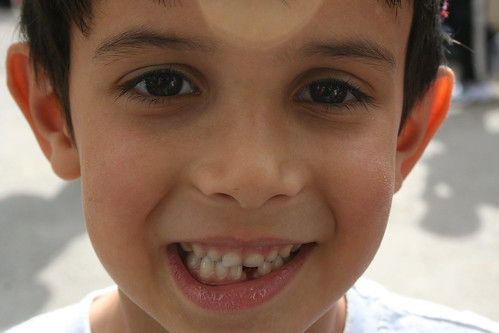
Benjamin lost a tooth. This is the first one. We have had a lot of firsts this year; it certainly changes your perspective on a place being there with kids. The thing of it is, the tooth just popped out, or he swallowed it without realizing. This will make things more complicated for the Tooth Dwarf, so Benjy is planning on writing a note explaining the situation and authorizing the Tooth Dwarf to use shrinking potion and go on a gastro-intestinal spelunking expedition.
I did say Dwarf. The Tooth Dwarf isn't an Israeli invention. It is a purely Wexler-Freedman creation.
Benjy showed his extremely loose tooth to our friends Annabelle and Sarah a few days ago. I wanted to ask if there was a Tooth Fairy in Israel but I had no idea how one says Fairy in Hebrew, so I asked if there was a "g'mad shinayim." Now putting Tolkein and his Hebrew translators aside for a moment, I felt that I was on solid ground. I had always seen g'mad as a catch-all word for "little, supernatural people." The root G.M.D. means shortened or constricted. It seems to be used in the Bible in only one place. It is actually a good story, about Ehud, one of the Judges of Israel, with a sort of a dwavish flavour to it and could easily be a bit out of the Hobbit, so allow me to digress.
The Israelites were being ruled by Moav. Ehud, despite being from the tribe of Benjamin (son of my right hand), was a lefty. He was supposed to pay tribute to Eglon the king of Moav, who the Bible says was very fat. Ehud made himself a special sword that was two-sided (literally, two mouthed) and shrunken in its length (gomed arka) and girded it on his right side presumably where nobody would expect a sword to be ("I frisked hundreds of young punks in my day," says Captain McKluskey right before Michael goes to get the gun out of the toilet tank).... Well, I think you can see where this is going. Ehud gives Eglon the present or tribute and then says he has a secret message for him and suggests they retire to the "upper chamber." That short sword goes right up to the hilt in the fat king's belly. Then Ehud walks out cool as a cucumber.
But all this is really neither here nor there except to say that any small and supernatural being can be a g'mad as far as I was concerned. But my friend Anabelle burst out laughing when I said a g'mad shinayim since her image of a g'mad is of a true, Tolkeinian dwarf, which she pointed out might have a very hard time climbing up to a bed to retrieve a tooth, as opposed to Tinkerbell who can just flit over. She informed me that in Israel they have a "Faya Shinayim." Now "faya" is a very recent coinage in Hebrew and derived from the Latin fata probably via French fey. I find that very disappointing for a culture with a rich tradition of bizarre supernatural speculation. Another friend told me that they had done a "malach shinayim" a tooth angel which at first I took to be a little -- well, saccharine -- but then I considered that malachim in Hebrew -- along with shaydim, demons -- really have cornered the market on Jewish folkloric magical beings. Plenty of malachim have strange and seemingly inconsequential jobs (standing over a blade of grass and encouraging it to grow), and others are hardly the benevolent-but-dull angels of a New Yorker cartoon, so why not have a malach in charge of collecting old teeth from under sleeping kids?
As for us we are happy with the idea of tooth dwarf. He may be less glamorous than a fairy or an angel but he is sturdier and probably better at navigating the dark and twisting intestinal tracks of a six year-old.

Tuesday, April 21, 2009

Yom Hashoah

I was just sitting and working away when the siren went for Yom Hashoah (Holocaust Remembrance Day). It has been many years since I was here for Yom Hashoah and I must have forgotten how intense the sound of the siren is or else I am closer to a siren station than I have ever been. It was a deeply powerful experience since the vibrations from the siren penetrate right into your body, shaking your bones as it were. Then it stops, but gradually with a sort of an exhausted and oddly organic moan which echoes for a few minutes as various sirens around the city die away, since something so penetrating cannot be cut off instantly. The sirens went off at 10:00 in the morning which has its own power because it gives you just enough time to get involved in your day-to-day activities and then get 'woken up' from them. I am at home and there is not much to see out the window here, no big roads with traffic coming to a standstill or crowds of people standing silently in a busy pedestrian walkway. What is extraordinary though is to look out at the little patch of the Jewish part of Jerusalem and consider that there are roughly the same number of Jews living in Israel today than died in the Shoah. A demographer recently published a report that said that there would be approximately 31 million Jews alive today if the Shoah hadn't happened in contrast with the 13 million today (That second number seems low to me and I am guessing it is using some slightly more restricted definition of 'Jew' than other demographers might use, but the point remains). It is hard not to imagine what differences there would be in Jewish life. How would our attitude to history be different? Our ideas about non-Jews? And Israel? What would the view look like out this window? All the good and also the bad that has been built here, would there be more apartment buildings, here, full of Jewish people living their domestic lives, hanging out their laundry on the line and sending their kids to daycare? Would there be fewer? Would there be a security fence encircling the city, snaking over the hills?
It is a beautiful time of the year in Jerusalem which adds to the power of the day. The city is in full bloom. Fields that were parched when we got here and only brown and grey are now bright green with lots of beautiful wildflowers, gigantic purple thistles and poppies, orange wild sweet peas. It is the season of smells here since the sun is bringing out every odor both good and bad. All the rosemary hedges are slowly baking and the lavender is flowering. When you walk by them, the bees look fat and happy and you think of the purple honey the must be making. The citrus trees are blossoming again and jasmine too which are very heady smells, so that you walk along the street and suddenly feel like you stepped into a pasha's pleasure garden in the thirteenth century and you look around and spot the culprit -- some orange or lemon tree or a bush with small white flowers -- looking very coy. As I said there are terrible smells emerging, too. I was pusing Lev in his stroller down Bethlehem Street past -- well, I won't mention the name of the restaurant -- which had had some kind of horrible bathroom malfunction and a giant vacuum truck was pumping out their septic tank or something.
It is public time in Jerusalem. With the warm weather everybody is out in the parks. Yesterday we celebrated Lev's birthday (a little late so that we could have a cake made from flour instead of Matzah meal). We did it in Gan HaPaamon (Liberty Bell Park) and it was packed. Mostly it was Palestinian/Arab-Israeli families who have a great culture of public barbeque picnics but there were a lot of Jewish teens out, too playing basketball and flirting and enjoying the warm (hot for Canadians) weather. There were sixteen-year-old girls on roller-blades looking very 'seventies, a pair of very put-together moms in hijabs, smoking a hukkah and blowing thick dragon-y plumes of smoke out their noses (I've never seen women smoking hukkah before). I saw the first Yiddish speaking Hasidic family I have come across in Jerusalem. We saw Japanese pilgrims. The park was just a great welter of people having a good time. Kids everywhere. We nearly lost a few but then the pizza came -- delivered to the park by our buddy from our local pizza store on a tus-tus -- and the kids all reconvened and we managed to hold on to them after that until everybody went home stuffed, filthy and high on sugar and fun.
Now, I have to go gear myself up for Benjy's questions about the Holocaust. We haven't ever talked to him about it because we always wanted his Jewish identity to be rooted in a sense of delight at being Jewish, not fear. It sort of crept up on us through school and he has been talking about it. He asked about relatives who were killed in the Holocaust and we told him that both of his grandmother's parents had been 'in the Holocaust' (How do you talk to a six year old about concentration camps. Or that his great grandparents wore tattoos for the rest of their lives? About how some people survived when others died and at what a terrible cost? How they didn't talk about what happened, ever?) I feel perfectly comfortable answering the questions about where do babies come from or about goldfish dying, but the question I am dreading is about the Shoah and it is "Why?"

Tuesday, April 14, 2009

Passover Reading

As I mentioned in a previous post, I have been reading the Hobbit in Hebrew. Thanks to David M. and Noa for lending us their copy. It is great reading. I probably haven't read it since I was twelve and am thoroughly enjoying it. I am reading it once to myself and more slowly Benjy and I are reading it together translating into English. There are occasional passages which I don't get and certainly words in most sentences which are hard but can be gleaned from context. It works well in Hebrew since it gives so much of the story that ancient once-upon-a-time feel that Tolkein worked so hard to give the book, when they get to the Dark Wood they are plunged into a choshech-Mitsrayim, "Egyptian darkness". I am using the translation by Moshe haNami which is vocalized which makes the reading so much easier. Vowels in Hebrew are written as dots and lines under the letters (though I recently learned that there were other systems which had voewels over the letters). Like Arabic, Hebrew is often written without the vowel marks -whch cn mk rdng prtt hrd. But kids books are often vocalized. If it wasn't for that I might have gotten the translation which was done by a group of Israeli POWs in an Egyptian prison. They worked on their English and one of the projects they did to keep themselves from going stir crazy (they were in from, I think, '67 until 1973; they said they were the only Israelis who were happy to see that war had broken out in 73 because it meant they had a chance of getting exchanged). They got a copy of the Hobbit in a Red Cross package and worked in teams to translate it and apparently produced a really good translation (though un-vocalized).
I had forgotten a lot of the book and occasionally I wonder if the translator just dropped in his own random bits and pieces. The whole thing with Beorn the bear-man, don't remember that at all. At this time of year The Hobbit has special resonance beyond the plague of darkness, since the dwarves are on a sort of journey of historical recuperation, to undo their exile as it were. Tolkien, in his letters, wrote about his dwarves being similar to Jews "I do think of the 'Dwarves' like Jews: at once native and alien in their habitations, speaking the languages of the country, but with an accent due to their own private tongue.....". Of course the little, tribalistic, bearded dwarves are on that long journey back to their home-land because they want their gold back and some people accused him of being anti-Semitic. But he wrote a pretty sharp letter to a German company who wanted to make sure he wasn't Jewish before they published their translation of the Hobbit.
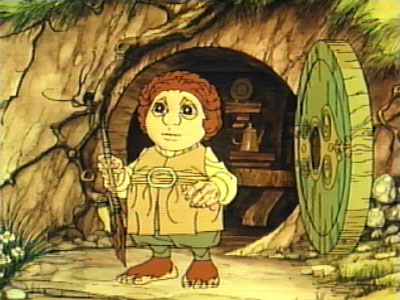
Bilbo strikes me this time around as a sort of Bertie Wooster figure, very proper and British, with a loathing of anything too out of the ordinary, very attached to his material comforts, nearly paralyzed at having left the house without his hat. The amount of time spent describing food in the book is certainly reminiscent of Wodehouse. Gandolf is Bilbo's Jeeves, pulling him out of tight spots at the last moment, never setting a foot wrong. It's sort of like Wooster and Jeeves accidentally ending up on trip to Israel with a dozen Belzer Hasidim where everything goes wrong, the wheels fall off the bus and the luggage all gets eaten by Orcs.
Maybe when I finish reading it, I will work on a translation into English so that non-Hebrew readers can finally enjoy this wonderful piece of literature.

Tuesday, April 7, 2009

Beautiful Benjy Art

Usually Ariela does the beautiful photography and I do the witty apercus about life in Israel, but she has broken that unwritten agreement with her extensive and very witty comments on her latest uploads, so I decided to upload some photos in retaliation. This is also convenient since we have been cleaning for passover and I haven't had any time to come up with any apercus. So here is an art work by Benjy; himself as capoeira-man. He had his belt ceremony the other day and tells anyone at the drop of a hat that he has a belt (yellow). I am also posting the picture that Ariela took of Lev all beat up and covered in ice-cream and pizza when we were on our way home from Mitzpe Ramon which Ariela refused to upload because she thought it might be evidence of child-abuse but which I think is evidence of a boy who had a good time.

Saturday, April 4, 2009

Mitzpe Ramon

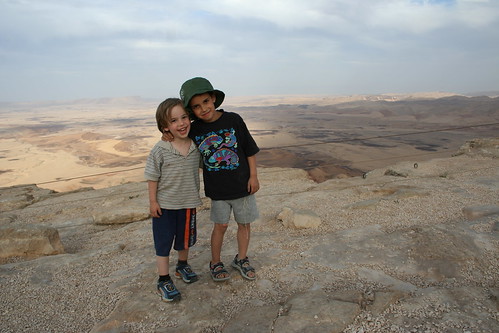
Schools here close down for a good week and a half before Passover so that the kids can help clean the house. With the kids home from school, we have done no cleaning but lots of entertaining our kids. We drove down to Mitzpe Ramon which overlooks the Ramon crater (where we saw the double rainbow when we drove through with Deb and Adriana last time). The boys had a good time. Both of them came home with various abrasions and contusions but Lev's were on his face so they were more visible. He fell once off the bunk-bed at the youth hostel and once in the wine storage cave in the ancient Nabatean city of Avdat. They ate nothing but pizza and ice cream for two days. Mitzpe Ramon is a strange place. It's pretty run down. The ibex wonder into town. Benjy loved that, seeing them as we walked back from the busted-up kids' park at the edge of town. Then they hop up on the wall at the canyon edge and over into space. Once, we came over a hill walking along the crater rim and saw this big mountain sheep not twenty feet away from us. He looked nonplussed. We were plussed.
For me one of the highlights of the trip was something that happened in the crater. We drove down and were going to hike but the boys were too tired, so I went off on a little explore by myself. I walked for ten or fifteen minutes seeing nothing but more of the same, wide open expanses of sand, rock and occasional scrubby bushes. Then I saw a big raptor flying ahead of me. There was one other way up and I assumed they were a mating pair. Then, he saw me and came over to take a look at me. He flew closer and closer until he was nearly overhead. I had stopped walking at this point and the absolute silence of the desert rushed in on me... it is startling this quiet, no bird calls, no bugs, no human sounds, just mile after mile of quiet, and I look up directly above and this lone hawk has flown into a cloud of enormous birds circling directly over me in the clear blue sky in these lazy overlapping helixes, maybe seventy five of them. The quiet and the blue and the dizzying quality of craning my neck made me feel like I was underwater and I was looking down at a school of sharks swimming beneath me. They were absolutely silent. There were two types, my raptor who had spotted me and got my attention and his kind which may have been a red hawks (Daih Aduma. The picture here is from the Israeli birding sight Moadon Tsiprut). They were big birds but the others were even larger. For a heartstopping moment I thought might be vultures because of their enormous wings and long necks. I knew that vultures wouldn't attack me but there was something about the idea of a swarm of fifty vultures thinking of me as carrion-to-be that really gave me pause. But vultures don't fly in big packs, they circle far apart and watch each other and only congregate on the ground. These were most likely some kind of migratory stork or crane. I have found no mention of them co-migrating with hawks. I remembered something that I read about the Gulag, about how when men escaped they would take a 'cow,' a fellow prisoner to eat on the way. I wondered if the hawks figure that traveling with a group of storks is a good way to get an easy meal if one of the storks founders. They circled for a while and then moved on and were replaced by another tower of birds and another. All completely quiet.
Benjy and I are reading The Hobbit in Hebrew. It is very fun. It took me a long time to figure out that the Shaydim -- which might roughly be translated as "demons" -- are the Orcs.

Saturday, March 28, 2009

Magic Haggadah

My hair has been restored to something approaching normalcy. Eitan Avshalom did his thing and I am now shorn. Which leaves me with nothing to write about except birds and Hebrew. (Of the seven people who read this blog three of them are ardent Jewish bird fans -- the rest hope to get actual information about my life and family. This one is more for the Hebreo-Ornithologists in the crowd.)
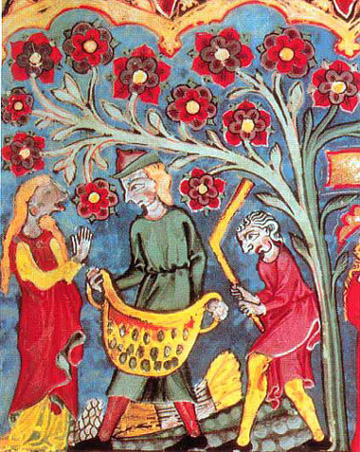
I would be remiss if I did not take the period approaching Passover to address the best known Jewish birds since the dove and the raven of Noah. I am talking about those grotesque, playful half-bird, half-Jew illustrations in what is known as the Bird's Head Haggadah. I went to a talk on Shabbat by David Golinkin about illustrated Haggadahs. (The haggadah is the book which lays out all the rituals and stories of Passover and has been the focus of a lot of Jewish artistic energy over hundreds of years.) He spoke about, among others, the Bird's Head Haggadah which is visually fascinating both because it is so lively and also because it is so weird. It is the only Haggadah which depicts human beings with non-human, specifically, bird heads. Balanced on top of their little bearded bird heads are Jew's hats. (In Medieval times, principally in Europe, Jews were often required by law to wear distinctive clothing, the Jewish star being only one example). They caper, they play, they get bake matzah. They generally look pretty happy about being redeemed from bondage. The Bird's Head Haggadah is dated to 13th century Germany. It is -- as far as I understand -- the only illuminated Haggadah from that place and period -- so it is a little hard to know how typical the whole bird thing was of those Haggadahs. It is however the only surviving Medieval haggadah which uses the bird's head device.
So why'd they do it?
The standard explanation was that some zealot had the idea that it was not okay to draw the human face, especially in a religious context, because of the second commandment. There are a number of problems with this theory. For one, there ARE human faces in the Bird's Head Haggadah. The Egyptians, it seems were drawn with human faces, just not the Jews. Second, Jews had a long-established tradition of drawing human faces by the 13th C. and nobody ever seemed to mind before, so why all of a sudden get picky? Third, is it so much better to draw a bird than a human? If the concern is idolatry, certainly idolatry to a bird-headed idol is about as bad as idolatry to a human-headed idol?
Theory two. "They will soar on wings of eagles..." says the prophet Isaiah (40:31). The illustrator is making a visual quotation appropriate to the idea of God redeeming the Jewish people. This is possible, but -- and this I did not know before -- there were other illustrated Jewish books from the period of German Jewry which also have humans depicted with animal and bird faces in a variety of contexts; apparently there was a little boom in animal headed humans in German Jewish art of the 13th Century! These have no apparent correlation to the animal's Biblical iconography. What is known as the Ambrosian Bible has a picture of a variety of were-humans enjoying the Feast of the Righteous at the End of Days where God serves up the Leviathan and other mythical menu items. (The picture reminds me of those creepy cartoon advertisements of pigs happily eating hot-dogs). And something called the Tripartite Machzor has all the WOMEN depicted as animals (The illustration is of Catwoman Ruth talking to human headed Boaz). Curiouser and curiouser.
Theory three. It was magic. A fellow named Moshe Carmilly-Weinberger (and David Golinkin agreed with him) argued that the half-human half-animal motif is evidence of some kind of magic. It is unclear to me from reading the article whether the magic is being depicted in the illustrations (ie. at the time the Jews were taken out of Egypt the world was transformed and the Jew's odd appearance as birds at the time is a manifestation of that. An obvious problem with this theory is that the Jews in the Bird's Head Haggadah, like most haggadahs, are not all depicted at the time of leaving Egypt, but, as the illustration above shows, are also doing contemporary Passover stuff; baking Matzah). Or the illustrations themselves are supposed to have some magical property to them (ie. having a Haggadah with these half-Jew half-bird creatures in them will protect you against the evil eye or some other force subject to supernatural control). Or both.
Another explanation, which makes about as much sense as these three that I haven't seen anyone else put forward, is that there were a lot of bird- and animal-headed people walking around Germany in the 13th Century, so the illustrators were just drawing what they saw. Then it got better.
Whatever the Why of it, the birds heads show a healthy Medieval delight in the grotesque and bizarre. More than that, I always get a kick out of those images of the bird-Jew with his Jew hat which suggest to me a kuntz, a playful messing with the Medieval non-Jewish depiction of Jews as supernatural, uncanny, humans-but-not-quite, like he could have a thought bubble over his head saying, "If that's the state of humanity, I think I'd rather stay a bird, thanks."

Monday, March 23, 2009

The Goods

In response to my previous post (the Year of Men with Hair, see below) my friend Rob said that I needed to show what the situation really was... that I couldn't bitch and moan about my hair and not come through with the goods. Well here it is. 45 lbs of hair standing perpendicular to the surface of my head. Fraggle, n'est pas?