Showing posts with label Israel. Show all posts

Thursday, April 23, 2009

Toothless in Gaza

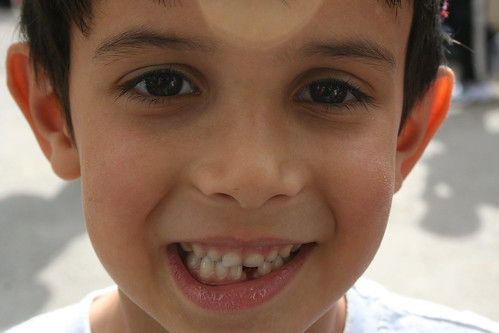
Benjamin lost a tooth. This is the first one. We have had a lot of firsts this year; it certainly changes your perspective on a place being there with kids. The thing of it is, the tooth just popped out, or he swallowed it without realizing. This will make things more complicated for the Tooth Dwarf, so Benjy is planning on writing a note explaining the situation and authorizing the Tooth Dwarf to use shrinking potion and go on a gastro-intestinal spelunking expedition.
I did say Dwarf. The Tooth Dwarf isn't an Israeli invention. It is a purely Wexler-Freedman creation.
Benjy showed his extremely loose tooth to our friends Annabelle and Sarah a few days ago. I wanted to ask if there was a Tooth Fairy in Israel but I had no idea how one says Fairy in Hebrew, so I asked if there was a "g'mad shinayim." Now putting Tolkein and his Hebrew translators aside for a moment, I felt that I was on solid ground. I had always seen g'mad as a catch-all word for "little, supernatural people." The root G.M.D. means shortened or constricted. It seems to be used in the Bible in only one place. It is actually a good story, about Ehud, one of the Judges of Israel, with a sort of a dwavish flavour to it and could easily be a bit out of the Hobbit, so allow me to digress.
The Israelites were being ruled by Moav. Ehud, despite being from the tribe of Benjamin (son of my right hand), was a lefty. He was supposed to pay tribute to Eglon the king of Moav, who the Bible says was very fat. Ehud made himself a special sword that was two-sided (literally, two mouthed) and shrunken in its length (gomed arka) and girded it on his right side presumably where nobody would expect a sword to be ("I frisked hundreds of young punks in my day," says Captain McKluskey right before Michael goes to get the gun out of the toilet tank).... Well, I think you can see where this is going. Ehud gives Eglon the present or tribute and then says he has a secret message for him and suggests they retire to the "upper chamber." That short sword goes right up to the hilt in the fat king's belly. Then Ehud walks out cool as a cucumber.
But all this is really neither here nor there except to say that any small and supernatural being can be a g'mad as far as I was concerned. But my friend Anabelle burst out laughing when I said a g'mad shinayim since her image of a g'mad is of a true, Tolkeinian dwarf, which she pointed out might have a very hard time climbing up to a bed to retrieve a tooth, as opposed to Tinkerbell who can just flit over. She informed me that in Israel they have a "Faya Shinayim." Now "faya" is a very recent coinage in Hebrew and derived from the Latin fata probably via French fey. I find that very disappointing for a culture with a rich tradition of bizarre supernatural speculation. Another friend told me that they had done a "malach shinayim" a tooth angel which at first I took to be a little -- well, saccharine -- but then I considered that malachim in Hebrew -- along with shaydim, demons -- really have cornered the market on Jewish folkloric magical beings. Plenty of malachim have strange and seemingly inconsequential jobs (standing over a blade of grass and encouraging it to grow), and others are hardly the benevolent-but-dull angels of a New Yorker cartoon, so why not have a malach in charge of collecting old teeth from under sleeping kids?
As for us we are happy with the idea of tooth dwarf. He may be less glamorous than a fairy or an angel but he is sturdier and probably better at navigating the dark and twisting intestinal tracks of a six year-old.

Monday, February 23, 2009

Sick kids and Kalaniyot

We are on day six thousand four hundred and twenty seven of home with the kids sick. First it was Benjy, for while it was Benjy and Lev, now it is just Lev. It is starting to lose its charm. Lev is up all night every night coughing. I don't think I have ever seen him so sick and it is breaking my heart. Fever, bad cough, listless... I really thought we might have to take him to the emergency room last night. This AM Ariela took him to the doctor who said I've seen fifty kids like this today. Take him home and give him an expectorant, bring him back in a few days if he's not feeling better, which made me glad we didn't shlepp to the hospital and wait four or five hours to be told the same thing. He is asleep now and so I am writing in the little break since my brain isn't up to much more.
I went out for a walk yesterday to try to regain my sanity (I know, it would have taken more than a walk even before the last week and a half) and made it about half way to Bethlehem. I went to the outer reaches of Kibbutz Ramat Rachel. Ramat Rachel changed hands three times in the war of Independence, between the Jordanians and the Israelis. There are still trenches and bunkers cut in the rocks out there. Now it is like a funny little suburb of Jerusalem at the southernmost tip of the city and from the south eastern tip you can see Bethlehem in the West Bank. It is funny how close everything is here. I walked in the woods there. It si a beautiful pine forest. I was hoping to find old coins. My friend David told me that after a big rain is a good time to find antique coins, but I didn't see any. There is a lot of garbage out there. It seems to be a favorite dumping ground, which is kind of a shame. I saw a spot where somebody had taken maybe forty old cell-phones and smashed them, and left the cases. I guess there is some sort of cell phone chop shop type business where you take out components and resell them. At any rate I also saw a few red kalaniyot coming into flower. Kalaniyot have a sort of mythic place in Israeli history. Natan Alterman one of the most popular poets of pre-state Israel wrote a poem called Kalaniyot which became a popular song...

Night comes, the sunset burns
I dream, the visions of my eyes
A small, young girl comes
And Kalaniyot, in flame, consume the valley...
My (probably pretty poor) translation of the first few lines.

כלניות / נתן אלתרמן

הערב בא, שקיעה בהר יוקדת
אני חולמת ורואות עיני:
הגיאה נערה קטנה יורדת
ובאש כלניות לוהט הגיא.

Though the flowers come in many shades, the classic is red and the berrets of the British soldiers during the period of the British mandate were red so the soldiers became known as kalaniyot. I don't know if Alterman meant that when he wrote the poem but there is a story that members of the underground Jewish resistance/terror (take your pick) organizations the lechi and the etzel would sing the song when British soldiers came near to alert one another.
A kalanit is an anemone, anemone coronaria, which I always thought was a poppy. It looks like a poppy to me, while an anemone I think of as something much bigger and floppier, though true poppies go by the latin name papaver, so don't try cooking up opium from kalaniot, it won't do you any good.
I wonder whether the Alterman poem or the use of the name Kalaniyot generally was connected at all to the famous English poppy poem which linked soldiers and the flowers "In Flanders Fields" (written by Canadian John McCrae. Incidentally, the last verse which I either never knew or had fogotten, changes the meaning of the poem from anti war to pretty blood-thirsty
Take up our quarrel with the foe
:
To you from failing hands we throw
The torch; be yours to hold it high.
If ye break faith with us who die
We shall not sleep, though poppies grow
In Flanders fields. A sentiment worthy of this part of the world in 2009.)

Kalaniot are native to this part of the world but I can't find them in Marcus Jastrow's dictionary of Rabbinic Hebrew nor in a search for the word in the bible so I am guessing it is a modern hebrew coinage, perhaps courtesy of Amos Oz's great uncle Joseph. People make a day of going to see the kalaniot in Israel in places where they bloom, like fire in a valley.

Thursday, February 5, 2009

Pride and prejudice

I learned a funny Hebrew factlet from reading Amos Oz's “Here and there in the land of Israel, Autumn 1982”. I came across a word I didn't know, which happens about five times a minute but this a word I couldn't quite get from the context and I was curious about it. In the book, Amos Oz is going around the country asking people what they think about the future of the country and the occupied territories. It is right at the end of the Lebanon war (the first Lebanon war). Menachem Begin is still Prime Minister. Huge demonstrations have taken place calling for his resignation. I guess it is as the revelations about Sabra and Shatilla are coming out. Anyway, Amos Oz goes to Bet Shemesh, which is today a bedroom community of Jerusalem. In 1982 it was divided, as he describes it, between the new city, which was suburban and Ashkenazi and old Bet Shemesh which is Sephardi, largely Moroccan, and, until recently, quite poor. This is hardcore Begin country. Apparently, a little while before he visited, Shimon Peres had been shouted down at a town-hall meeting there and ended up calling the hecklers “birionim” “thugs” which confirmed all of Bet Shemesh's suspicions that Peres was a prejudiced, effete, Ashkenazi, elitist. Anyway, not long after that along comes Amos Oz, this Ashkenazi, (former) kibbutznik, lefty (at the time) activist writer. And he plunks himself down at a cafe. Somebody recognizes him and pretty soon he's got thirty guys around him telling him “Write this down...” “Tell your friends in the media this....” “Your problem is...” “You should thank God for Begin, get down on your knees and kiss his feet...” “When my parents came from Morocco, you people made them clean toilets...” “Yossi, get the man another soda, and some bourekas...” Anyway, at one point one of the guys says to him, “If you want to fix what you did to us, you need to come and ask for forgiveness, but without 'shachatsanut', forget the 'shachatsanut'.”

It seemed odd to me because the sense seemed to mean 'pride', but Hebrew has a very good word for pride: “gavah”. I remember once at this very religious school I used the term gavah, in its yiddish pronunciation “gayvah” and asked the kids what that meant and one boy, a round little kid with glasses, did a funny stretch of his neck, stuck his nose in the air and said in his snootiest voice, “haughtiness.”

Anyway, I was sitting reading Amos Oz at the Matnas in Baka, the community centre while Benjy was at his Caipoera class. I turned to a lady sitting near me and I said, “What is shachatzanut?”

She said “It's to say that you're better than someone or that you think you're so great.”

“Like 'gavah'?” I asked.

She said, “Well it comes from 'gavah.' But it's negative.”

Then I realized what the issue was. I had even seen it without realizing it in Oz's book, which is in some sense about pride. Gavah, pride in any pre-modern Jewish context is, (I think. Feel free to correct me) always negative. Its opposite is humility which is viewed as a tremendously positive attribute most embodied by no less a figure than Moses. There is no such thing in Jewish religious thought as -- and so no semantic expression for – pride as a positive or even neutral quality. But when Hebrew became a language of daily use again in the context of national revival and Jews wanted to express feelings of positive pride, which they most certainly did, they used gavah, stripping it of its negative connotation (maybe even as a finger in the eye of a religious world-view that saw all pride as a negative). So when people want to say to Amos Oz that they felt proud when Israel won the Six-Day War, or that leftists lack pride in the country, or that Begin restored the pride of the Sephardim, they say “gavah” or something derived from it. But that shift leaves Israeli Hebrew speakers with the problem of how to express negative pride, haughtiness.

Shachatz, the most stripped down form of shachatzanut, seems to have been used mostly in the Jerusalem Talmud and it meant something like a character flaw. Since pridefulness was such a central fault in Jewish religious thinking, the two became identified. “That person has a character flaw,” was understood to mean, “that person is proud.”

There's a joke about a rabbi and a cantor on Yom Kippur in the synagogue. First the Cantor goes before the congregation and turns to the ark where the Torah is kept and cries out in a loud voice, “Oh Lord, forgive me for I am as nothing in your sight” The rabbi, then gets up stands before the ark and says, “Oh Lord forgive me for I am as nothing in your sight.” Yankle Yossef, the butcher is genuinely moved. He runs up to the ark and cries out, “Lord, forgive me for I am as nothing in your sight.” The rabbi turns to the cantor and says, “Oh, ho! Look who thinks he's nothing!”


It is warm here, unseasonably so according to people who live here. Daffodils are flowering. The cyclamens – which I still can't believe actually flower wild anywhere are almost done and as per the song the almond trees are flowering. Pretty much like Montreal.

Tuesday, February 3, 2009

The Arab-Israeli conflict as seen by Chuck Jones, Birds and What I'm Reading

My mother called me up the other day and said “What happened to your blog?” I was amazed that anyone noticed that I hadn't updated it. Then she told me that “all her friends” were reading it, too and were very worried about me. For a writer there is no better prod to writing than having a reader or (ptu, ptu, ptu, ken ein haorah) several, so with my vanity stoked I am back.

I will tell you – Mother and mother's friends, and anyone else who happens along – that the reason I wasn't writing is because I just couldn't write about politics because of the ahhhhhh!!! $%@^#*!!!! -factor and I couldn't not write about politics.

I was sitting with the boys watching Road Runner the other day. As the coyote prepared to drop an Acme mail-order anvil on the roadrunner's head which everyone in the world except him knows is going to squash him not the roadrunner, I found myself asking “Are the Palestinians the roadrunner or the coyote? Who are the Israelis?”

This explains why or maybe how it is that people here end up ignoring politics when it is so important; If you think about it at all you have to think about it all the time and if you do that you are on the slippery slope to becoming a politician. Before the ink is dry on your nomination papers you are taking greasy shopping bags full of cash from a shadowy Miami billionaire... and Klong!!!! That anvil you dropped before just whacked you on the head.

Bird update: I have recently seen a Syrian woodpecker, a noisy family of jays and my first hoopoe. The hoopoe was over in Mamilla, where there are these weird old houses just west of Gan Haatzmaut. They are really run-down and it is funny to come upon what looks like the left-overs of a little Arab village across the street from the Sochnut building, the Jerusalem Sheraton and the Great Synagogue. Anyway, I heard him before I saw him and followed the sound to a dead tree where he was sitting sounding very much like an owl in the day time... whoo whoo, whoo whoo. He is called a duchifat in Hebrew which is a biblical name from the list of birds considered unclean for eating in Leviticus 11. He is the national bird as recently chosen by popular vote. Like all politicians he looks just the same in person as he does in pictures. A friend pointed out to me that all the candidate birds are non-migratory, so sojourners like us are out of the running. She works at the Arab-Jewish school in Pat and she said that when the contest was running all her Palestinian students were voting for the Palestine Sunbird because it had Palestine in its name – (in English and Arabic, not in Hebrew where it is called – I think -- the tsufit).

I am now very close to having seen all the birds on the list of candidates. I still have to see an Egyptian vulture who I mentioned in previous posts, I think. There are no roadrunners in Israel at least outside of cartoons and politics so they did not make the list.


PS. A shout out to Sam Fraser in Nova Scotia if he is reading... I took a break from Israeli writers and read “The Tombs of Atuan” and some of “The Wizard of Earthsea” in Hebrew. You see that I am susceptible to commanding booksellers.

I am now making my way – slowly -- through a book of essays by Amos Oz, the Hebrew title of which is “Here and there in the land of Israel in fall of 1982” but which I think is the same as “Amos Oz In the Land of Israel” in English. On the Hebrew difficulty scale, I would give it a 7. The reportorial style makes it easier than a novel. I also read Canadian Edeet Revel's “The Ten Thousand Lovers” which was pretty good and is set largely in Jerusalem which made it extra fun, though it is certainly not a book to give your brain a rest from the idiocy-loop of Israel/Palestine.