We all went out for pizza last night. Benjy had his capoeira class, we went to the library and then headed over to Bethlehem street loaded down with Asterix (in Hebrew and French -- apparently the English library volunteers don't believe in Asterix or Tintin). This was sort of a celebration of a return to normalcy after the boys being so sick. It was a lovely evening sort of late spring early summer type weather back in Montreal (we are supposed to be getting more rain and cold weather over the weekend). The sky was just turning pink and dark blue when I saw what I thought ate first were alpine swifts flittering high in the sky, and chirupping madly. Then it occurred to me that they might very well be bats. Now I am pretty sure that that's what they were. I am generally well inclined towards bats. Atalef, the word for bat, is one of the first Hebrew words we learned on this trip as a family from a kindly volunteer at the Jerusalem zoo. It is listed in the Torah as one of the flying creatures that you are not allowed to eat, so has the honour, unique as far as I know of, of being doubly prohibited, since it is also a mammal which doesn't have a cloven hoof and doesn't ruminate.
I'm not sure if I mentioned it but when we went to Caesaria on the Mediteranean coast, we saw a series of old Roman/Herodian vaults, once cellars for a long-vanished building that stood atop them. In the third of these vaults, the one closest to the ruins of the Crusader castle, there is a bat colony. I took each of the boys inside to take a closer look. They are definitely otherworldy creatures and while I was fascinated -- a feeling I tried to share with the boys -- I also was a little freaked out -- a feeling I did my best to hide. The bats last night weren't at all scary since they were so small and fragile looking though their flight looks kind of clumsy and hurried.
An addendum to my previous post about Amos Oz and the various ways that one might express pride in Hebrew. In Yiddish, naches is a word often used for something like pride. Naches comes from the Hebrew nachat, which means something like satisfaction. In the very first essay of the book (Here and There in the Land of Israel, Fall 1982) Oz goes to the neighbourhood where he grew up, near Meah Shaarim, which is now called Geula. It is now an ultra-Orthodox neighbourhood. He chats with a representative of one of the local schools, about, among other things, Zionism. The man tells him the state of Israel is "goyische naches." There is a real irony to this phrase in the context of nationalism. The speaker means Gentile pride or satisfaction, or less kindly, the stupid things that non-Jews value which Jews are, supposedly, too sensible to race after. The irony rests in the fact that goyishe literally means 'of the nations.'
I found it funny to discover that Oz, who is so disdainful of the ultra-Orthodox, uses the same phrase (almost exactly) later in the book when he is addressing a group of West Bank settlers. He says that while he is a Zionist, he sees the state of Israel as an instrument, not an end in itself and as far as he is concerned feelings of patriotism stirred by the flag, the passport or the army are "goyim naches" (I am not sure about the difference between goysiche naches and goyim naches). Of course the irony is that Oz's vision is a pretty humanistic one (for an ardent nationalist...)
(My Translation)
"Here is the place for my first little confession.... I think that the nation-state is a vessel or a tool, that it is necessary for the 'settlement of Zion'. But I don't love this tool. The idea of the nation state is in my eyes 'goyim naches' (Gentile pride). I would have been happy to live in the world in which there are several tens of civilizations developing according to their own rhythms. With mutual respect but with no nation-states: no flag, no symbol, no passport, no anthem, nothing, just spiritual civilizations, each one connected with its land, without the 'instrument of state' and without the 'instrument of weapons'.
"But the Jewish people already did a solo performance like that, a very long one. The viewing public, the world, gave us a big hand, sometimes threw rocks and even tried to kill the actor. Nobody was interested in the model that Jews tried to set up for two thousand years, the model of a civilization without the 'instrument of state'. For me, that drama ended with the murder of European Jewry by Hitler. I am willing to play the 'game of the nations' with all the instruments of a state even if that means that I will end up feeling -- in George Steiner's phrase -- like an old man in a play-ground. Playing with a symbol and a flag and a passport and an army and even war, are allowed in the case of existential necessity. I accept these as "rules of the game" since going on without the 'instrument of the state' put us in danger of our lives. For sure. But to admire the instruments of state? To revere these toys? To go crazy over them? Not me. And if we wield the instruments of the state including its deadly power, we need to act not just with loyalty but with wisdom. I would say without loyalty. Only with wisdom. And with caution. Since nationalism itself is, in my eyes, the great curse of humanity."
This last forms a nice corrective to Israel Beitenu's demands of loyalty to the state, and the ideology that underpin them, in the recent elections.
Showing posts with label Amos Oz. Show all posts
Showing posts with label Amos Oz. Show all posts
Thursday, February 26, 2009

Thursday, February 19, 2009
Birds imitate life.
There are a lot of blackbirds around these days or maybe I am just noticing them more. They are unremarkable looking but they have a beautiful song and the last few mornings as I walk with one or the other of the boys, I hear them whistling happy away. Benjy and I heard them this morning. I told him that the Hebrew name is Shacharur and we talked about whether the word comes from Shachor - black or from Shachar, morning. Probably both. It isn't a Biblical name nor is it Rabbinic as far as I can tell. Another possible origin is shachrur: freedom or independence. (As in Gan haShachrur, Independence Park where I saw the Hoopoe in my last posting). Some bright light of the Hebrew renaissance probably put all those things together and came up with the name for the blackbird (which is certainly nicer than Turdus merula, the latin name). Or maybe shacharur is from Arabic and has nothing to do with morning or black or freedom.
Anyway blackbirds are big news, here. HaAretz had a piece today about how urban birds are adapting to city life.
"There is a blackbird in Jerusalem's Sacher Park that imitates the whistle sounds men make at girls, and has simply incorporated those sounds into his regular songs," says Amir Balaban, of the Society for the Protection of Nature in Israel, noting that girls even turn their heads at the blackbirds' whistle. (That's Amir from the bird observatory of a previous post, by the way).
So I went down to Sacher park -- which is right next door to the Kenesset -- to see if I could find the sexual-harrassing Shacharur. I didn't, but I did hear a blackbird chirping "I won't join your coalition unless you make me minister of the interior, and I don't care how many indictments there are against me." I even turned around and looked.
Finally, as I have mentioned, I am reading Amos Oz's "A Tale of Love and Darkness." He talks a lot about his great uncle Joseph Klausner who lived a few blocks away from here (In a funny passage Oz talks about how S.Y. Agnon and Uncle Joseph were life-long enemies living on the same street. Klausner died before Agnon won the Nobel prize for Literature, thereby sticking it to Agnon twice, once because Agnon couldn't flaunt his success, and the second time because the city named the street -- where Agnon continued to live for the rest of his life -- Klausner street). Anyway, Oz tells of his admiration for Klausner's having minted several new Hebrew words, including 'shirt' and 'pencil', how as a writer you can write books and they will get read until some better book comes along but making a new word is a whole other order of impact. One of the Hebrew words in the list that great Uncle Joseph was responsible for is "crane." That jumped out at me because I had noticed that -- just like in English -- the word for crane comes from the bird; they are both 'agur.
I'll see if I can spot any cranes of either variety the next time I am up on Klausner street and promise to listen attentively and report back any thoughts they share on language or politics or picking up girls.
Anyway blackbirds are big news, here. HaAretz had a piece today about how urban birds are adapting to city life.
"There is a blackbird in Jerusalem's Sacher Park that imitates the whistle sounds men make at girls, and has simply incorporated those sounds into his regular songs," says Amir Balaban, of the Society for the Protection of Nature in Israel, noting that girls even turn their heads at the blackbirds' whistle. (That's Amir from the bird observatory of a previous post, by the way).
So I went down to Sacher park -- which is right next door to the Kenesset -- to see if I could find the sexual-harrassing Shacharur. I didn't, but I did hear a blackbird chirping "I won't join your coalition unless you make me minister of the interior, and I don't care how many indictments there are against me." I even turned around and looked.

Finally, as I have mentioned, I am reading Amos Oz's "A Tale of Love and Darkness." He talks a lot about his great uncle Joseph Klausner who lived a few blocks away from here (In a funny passage Oz talks about how S.Y. Agnon and Uncle Joseph were life-long enemies living on the same street. Klausner died before Agnon won the Nobel prize for Literature, thereby sticking it to Agnon twice, once because Agnon couldn't flaunt his success, and the second time because the city named the street -- where Agnon continued to live for the rest of his life -- Klausner street). Anyway, Oz tells of his admiration for Klausner's having minted several new Hebrew words, including 'shirt' and 'pencil', how as a writer you can write books and they will get read until some better book comes along but making a new word is a whole other order of impact. One of the Hebrew words in the list that great Uncle Joseph was responsible for is "crane." That jumped out at me because I had noticed that -- just like in English -- the word for crane comes from the bird; they are both 'agur.
I'll see if I can spot any cranes of either variety the next time I am up on Klausner street and promise to listen attentively and report back any thoughts they share on language or politics or picking up girls.
Friday, February 13, 2009
Election day was a day off for the boys so we went out to the Tayelet and looked at the Old City wrapped in mist. We walked all the way around the Hill of Evil Counsel where the British Governor's residence was during the mandate period and where the UN observers post has been ever since, crossing over from West Jerusalem to East and back again, something we may not be able to do the next time we come. A lot of Amos Oz's book "the Hill of Evil Counsel" takes place in the governor's residence. The mother of the young boy, wife to the veterinarian, gets swept off her feet by a handsome British general. That's what I though about most when I was out there, among the big pine trees(that and the story of Saul and David which we ended up telling collectively as we walked, with many silly interpolations by all concerned especially when we told the story of Goliath and with added details about his halitosis, his taunting of the Israelites by mooning them etc.). In "The Hill of Evil Counsel" the young boy's beautiful, ethereal mother wanders off with the general into the gardens that we walked past. I read that book in the easy Hebrew version right before we came and it gave me the hankering to read modern Israeli literature which has driven my Hebrew reading kick this year... I am reading Amos Oz's A Tale of Love and Darkness, (in English) a memoir which I am actually finding pretty dry, though it gives a lot of interesting stories about his life as a boy in Jerusalem. I didn't know that his own mother committed suicide. 
By the time we headed back into West Jerusalem it was getting windy and looked like rain. We went to Waffle Bar on Derech Bethlehem street. The boys ordered waffles which were as big as them and came with ice cream and whip cream and we all thoroughly enjoyed stuffing ourselves. There was barely any indication that it was election day as we walked around the city. It was so different from the municipal elections where our street corner was a battleground between different candidates's teams.
Benjy has a cold. He stayed home Friday and couldn't go to shul on Shabbat so I had to take his place in the Parsha players (about once a month they stage a little sketch about the weekly reading from the bible, kids and adults participate... it is cute, but a lot cuter to watch than to participate in). Anyway I was Israelite #3. I had one line. "Hishtagata!?" Have you (masculine, singular) gone crazy?!
This is a good Hebrew phrase to know, since it is appropriate to so many circumstances here. Use it in conversation today.
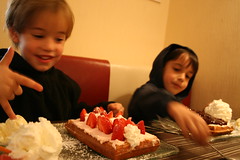
By the time we headed back into West Jerusalem it was getting windy and looked like rain. We went to Waffle Bar on Derech Bethlehem street. The boys ordered waffles which were as big as them and came with ice cream and whip cream and we all thoroughly enjoyed stuffing ourselves. There was barely any indication that it was election day as we walked around the city. It was so different from the municipal elections where our street corner was a battleground between different candidates's teams.
Benjy has a cold. He stayed home Friday and couldn't go to shul on Shabbat so I had to take his place in the Parsha players (about once a month they stage a little sketch about the weekly reading from the bible, kids and adults participate... it is cute, but a lot cuter to watch than to participate in). Anyway I was Israelite #3. I had one line. "Hishtagata!?" Have you (masculine, singular) gone crazy?!
This is a good Hebrew phrase to know, since it is appropriate to so many circumstances here. Use it in conversation today.
Thursday, February 5, 2009
Pride and prejudice
I learned a funny Hebrew factlet from reading Amos Oz's “Here and there in the land of Israel, Autumn 1982”. I came across a word I didn't know, which happens about five times a minute but this a word I couldn't quite get from the context and I was curious about it. In the book, Amos Oz is going around the country asking people what they think about the future of the country and the occupied territories. It is right at the end of the Lebanon war (the first Lebanon war). Menachem Begin is still Prime Minister. Huge demonstrations have taken place calling for his resignation. I guess it is as the revelations about Sabra and Shatilla are coming out. Anyway, Amos Oz goes to Bet Shemesh, which is today a bedroom community of Jerusalem. In 1982 it was divided, as he describes it, between the new city, which was suburban and Ashkenazi and old Bet Shemesh which is Sephardi, largely Moroccan, and, until recently, quite poor. This is hardcore Begin country. Apparently, a little while before he visited, Shimon Peres had been shouted down at a town-hall meeting there and ended up calling the hecklers “birionim” “thugs” which confirmed all of Bet Shemesh's suspicions that Peres was a prejudiced, effete, Ashkenazi, elitist. Anyway, not long after that along comes Amos Oz, this Ashkenazi, (former) kibbutznik, lefty (at the time) activist writer. And he plunks himself down at a cafe. Somebody recognizes him and pretty soon he's got thirty guys around him telling him “Write this down...” “Tell your friends in the media this....” “Your problem is...” “You should thank God for Begin, get down on your knees and kiss his feet...” “When my parents came from Morocco, you people made them clean toilets...” “Yossi, get the man another soda, and some bourekas...” Anyway, at one point one of the guys says to him, “If you want to fix what you did to us, you need to come and ask for forgiveness, but without 'shachatsanut', forget the 'shachatsanut'.”
It seemed odd to me because the sense seemed to mean 'pride', but Hebrew has a very good word for pride: “gavah”. I remember once at this very religious school I used the term gavah, in its yiddish pronunciation “gayvah” and asked the kids what that meant and one boy, a round little kid with glasses, did a funny stretch of his neck, stuck his nose in the air and said in his snootiest voice, “haughtiness.”
Anyway, I was sitting reading Amos Oz at the Matnas in Baka, the community centre while Benjy was at his Caipoera class. I turned to a lady sitting near me and I said, “What is shachatzanut?”
She said “It's to say that you're better than someone or that you think you're so great.”
“Like 'gavah'?” I asked.
She said, “Well it comes from 'gavah.' But it's negative.”
Then I realized what the issue was. I had even seen it without realizing it in Oz's book, which is in some sense about pride. Gavah, pride in any pre-modern Jewish context is, (I think. Feel free to correct me) always negative. Its opposite is humility which is viewed as a tremendously positive attribute most embodied by no less a figure than Moses. There is no such thing in Jewish religious thought as -- and so no semantic expression for – pride as a positive or even neutral quality. But when Hebrew became a language of daily use again in the context of national revival and Jews wanted to express feelings of positive pride, which they most certainly did, they used gavah, stripping it of its negative connotation (maybe even as a finger in the eye of a religious world-view that saw all pride as a negative). So when people want to say to Amos Oz that they felt proud when Israel won the Six-Day War, or that leftists lack pride in the country, or that Begin restored the pride of the Sephardim, they say “gavah” or something derived from it. But that shift leaves Israeli Hebrew speakers with the problem of how to express negative pride, haughtiness.
Shachatz, the most stripped down form of shachatzanut, seems to have been used mostly in the Jerusalem Talmud and it meant something like a character flaw. Since pridefulness was such a central fault in Jewish religious thinking, the two became identified. “That person has a character flaw,” was understood to mean, “that person is proud.”
There's a joke about a rabbi and a cantor on Yom Kippur in the synagogue. First the Cantor goes before the congregation and turns to the ark where the Torah is kept and cries out in a loud voice, “Oh Lord, forgive me for I am as nothing in your sight” The rabbi, then gets up stands before the ark and says, “Oh Lord forgive me for I am as nothing in your sight.” Yankle Yossef, the butcher is genuinely moved. He runs up to the ark and cries out, “Lord, forgive me for I am as nothing in your sight.” The rabbi turns to the cantor and says, “Oh, ho! Look who thinks he's nothing!”
It is warm here, unseasonably so according to people who live here. Daffodils are flowering. The cyclamens – which I still can't believe actually flower wild anywhere are almost done and as per the song the almond trees are flowering. Pretty much like Montreal.
Subscribe to:
Posts (Atom)

 Posts


